
Special Olympics tests reverse vending accessibility
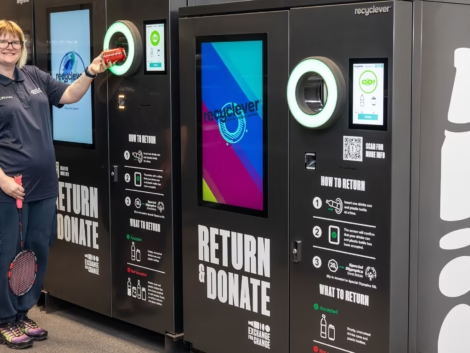
A trial at this week’s Special Olympics GB National Summer Games in Birmingham is testing how people of all abilities interact with reverse vending machines, as organisers look to build accessibility into the UK’s Deposit Return Scheme (DRS) before it launches in October 2027.
The trial, running from 27 to 30 August at Alexander Stadium, is a partnership between Coca-Cola Europacific Partners (CCEP), the scheme operator Exchange for Change and Special Olympics GB. Hundreds of athletes with intellectual disabilities, alongside spectators and volunteers, will use reverse vending machines supplied by Recyclever and Sielaff during the Games.
Exchange for Change will conduct on-site research, gathering feedback from athletes, carers, supporters and visitors on how clearly the machines, their instructions and DRS messaging are understood. The aim is to identify where barriers exist and what changes could make the scheme more accessible when it goes live nationally.
Athlete leaders from Special Olympics GB were consulted ahead of the event to shape the trial’s artwork and instructions.
Jo Padwick, senior sustainability manager at CCEP, said the trial was about listening to users. “This trial gives us a chance to see how people use reverse vending machines during a busy event, understand what works well and what could work better, and use those learnings to help shape a more accessible scheme when it launches in 2027.”
Laura Baxter MBE, chief executive of Special Olympics GB, said people with intellectual disabilities were too often expected to adapt to systems designed without them in mind. “Our athletes will be helping to test and shape a scheme that millions of people will use. That is inclusion in action – recognising people with intellectual disabilities not simply as participants, but as experts whose experiences and ideas can make things work better for everyone.”
DRS preparation accelerates
The UK’s DRS, covering PET plastic, steel and aluminium drinks containers between 150ml and three litres, is scheduled to launch on 1 October 2027 with an expected 20p deposit. Exchange for Change, the designated operator for all four UK nations, confirmed earlier this year that return handling fees will be set at 3p per container for manual return points and on a tiered basis for automated machines.
The accessibility question is not confined to people with intellectual disabilities. Reverse vending machines will be the primary return infrastructure for most consumers, and their usability – screen height, instruction clarity, physical access for wheelchair users – will affect whether the scheme meets its collection targets of 70 per cent in year one, rising to 90 per cent by year three.
Russell Davies, Exchange for Change chief executive, said the trial would inform future accessibility guidance. “Working with Special Olympics GB allows us to hear directly from people with a wide range of lived experiences, helping ensure inclusion is embedded in the rollout of DRS across the UK.”
The Special Olympics GB National Summer Games is the organisation’s largest event since 2017, with more than 1,200 athletes competing in 15 sports across venues in England, Scotland and Wales.


