RHODIUS Mineralquellen and KHS implement project with resealable aluminium bottles
When deep trust meets the courage to innovate, solutions emerge that drive the beverage industry forward. RHODIUS Mineralquellen und Getränke GmbH & Co. KG and the KHS Group demonstrate precisely this with the first high-performance line for resealable aluminium bottles in Germany. An existing KHS can line, capable of producing up to 50,000 containers per hour, was upgraded and recommissioned for the new Alu-Bottle format in just nine months.
RHODIUS Mineralquellen has relied on KHS expertise for more than 50 years. Initial joint projects have evolved into a close and long-standing partnership, as Hannes Tack, Managing Partner at RHODIUS, emphasises: “KHS has been a reliable partner at our side since 1970. The team has an in-depth understanding of our requirements, needs, and facilities. This understanding is invaluable, especially for highly complex projects.” This long-standing collaboration is also reflected in the numerous investment projects of recent years, where RHODIUS has consistently relied on KHS technology. The beverage producer and contract bottler of well-known brands such as Bluna and Afri Cola now operates six KHS lines – three for cans and one each for kegs, glass bottles, and PET bottles.
Open to new technologies and packaging solutions,
Both companies share a strong pioneering spirit, according to Tack: “We are very open to new technologies and packaging solutions. For us, KHS is the ideal partner for implementing innovations on a large scale. We have complete confidence in the company’s technical and human expertise.” Therefore, when it came to integrating screw-cap aluminium bottles into the product portfolio in 2025, the choice once again fell on the Dortmund-based systems provider.
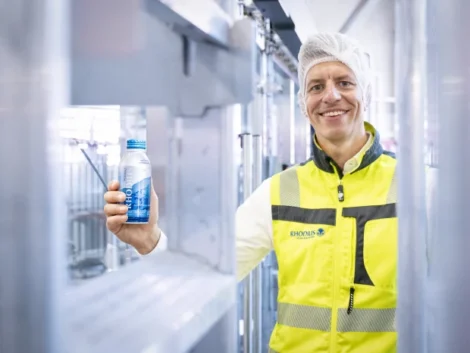
The requirements for this major project were demanding – after all, RHODIUS and KHS are among the pioneers bringing high-performance, resealable aluminium bottles to the European market. While these containers have been a staple in the Japanese packaging market for many years, they are hardly used in Europe. Yet, they offer clear advantages over other beverage container concepts, as Tack explains: “Many brands are looking for high-quality alternatives that can be integrated into existing recycling systems and that allow them to stand out from the competition at the point of sale. Our packaging solution offers great potential here, especially for trendy ready-to-drink beverages such as functional drinks, flavoured water, and energy drinks.” According to Tack, it combines the high functionality and convenience of resealable bottles with the visual and tactile appeal, as well as the recyclability, of aluminium cans. In Germany, according to a study by the Society for Packaging Market Research ( GVM ), more than 99 percent of all beverage cans are recycled, while the European average is 76 percent.
Pioneering work under challenging conditions:
RHODIUS envisioned integrating the new aluminium bottle with a screw cap into an existing KHS production line at the Burgbrohl site. The clear requirement: ongoing operations must not be disrupted. The limited space and the ambitious nine-month integration timeline also presented significant challenges.
During the planning phase, the KHS team once again benefited from its excellent knowledge of the production facility and its long-standing familiarity with the processes and contacts on site. “At the start of the project, we explored numerous scenarios and mentally integrated the new packaging into various lines,” says KHS Project Manager Gerd Bodenheimer. The 3D plant planning provided by the full-service supplier was a great help. “This allowed us to easily simulate every conceivable scenario, relocate existing equipment, and integrate potential new machinery.”
Successful conversion of an existing can line:
The final choice was an existing KHS can line with an output of up to 50,000 containers per hour. To achieve this, RHODIUS invested in new unloading, filling, labelling, and inspection technology. An unusual approach was chosen for filling: instead of a conventional can filler, the Innofill Glass DNRF was used.KHS is now in operation on the line. “We deliberately opted for a long-tube filler. The long tube gently introduces the beverage just above the bottom of the container, displacing the oxygen upwards and thus ensuring optimal oxygen levels in the product,” explains Thomas Hüser, Technical Sales at KHS. Thanks to volumetric flow measurement, the glass filler can fill a wide range of products without any loss of quality – indispensable for a large beverage producer and contract bottler like RHODIUS.
The conversion of the unloading units also required unconventional solutions. Both the existing and the new KHS Innopal AS 1 HZ unloading units were quickly relocated to the basement of the production hall. Furthermore, two can fillers were decoupled from each other during this process. The new arrangement ensures that both the empty cans and aluminium bottles for all lines are delivered to a single point. A key challenge was transporting the empty containers to the filling line above. The vacuum transport system from KHS partner HF Meyer ultimately proved to be the ideal solution.
Pilot project for the European market:
RHODIUS sources the aluminium bottles with screw caps already painted from Japan, a key production location for this packaging solution. “Only a few producers worldwide have mastered the technology to manufacture lightweight, resealable aluminium bottles. Unfortunately, there isn’t a single manufacturer in Europe at present,” says Tack. With this new investment, RHODIUS is driving the development of the European market and simultaneously stimulating stronger regional production.
For legal reasons, the containers, painted in Japan, are delivered without the deposit logo. RHODIUS ensures the application of the DPG logo using the KHS Innoket Neo labeler . At the same time, the machine provides additional flexibility: The filled containers can be individually designed and labelled with customer-specific labels. This offers significant advantages, especially for a contract bottler. The KHS Innocheck LIS label inspection system ensures final quality control. It uses a camera to check whether labels are present and in the correct position.
Goals successfully achieved.
The rebuilt line was commissioned in July 2026. “From planning and assembly to commissioning, all processes ran smoothly. Normally, a project of this scale takes more than a year. The fact that we completed the conversion in nine months while maintaining operations is a tremendous achievement by everyone involved,” praised Tack.
To ensure a seamless transition to operation, RHODIUS employees were closely involved in the assembly and commissioning process. The KHS team trained the operators directly at the machine. In addition, targeted maintenance training is being conducted. The KHS remote maintenance system ReDiS is used for minor maintenance and repairs. The combination of on-site training and digital services supports operation, maintenance, and continuous machine operation.
The redesigned line has regained its original output of up to 50,000 bottles per hour and has processed the first marketable products. RHODIUS is initially bottling its own water brand in 400 ml bottles and a Halloween special edition of the Bluna brand. Further product launches are planned for the end of the year. “We are also currently in promising discussions with national and international brands regarding potential collaborations. And with each collaboration, we come one step closer to our goal of enriching the European beverage and packaging industry with an innovative and high-quality container solution.”